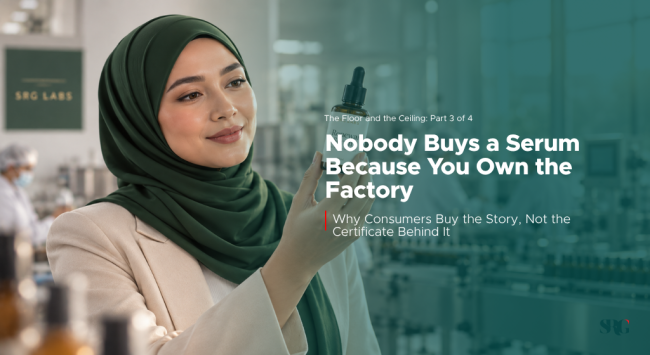
If you’ve ever pitched your brand to a buyer, an investor, or a journalist, there’s a good chance you led with this line: “We manufacture our own products, to our own standards, in our own facility.” It’s true, and it’s meant to project trust. It’s also a sentence that reassures a procurement officer, not one that interests a customer.
The consumer buying your serum at a pharmacy in Riyadh doesn’t know which factory filled the bottle. They don’t care. They care about the brand, the story, the person behind it, and whether the product does what it promises. “We make it ourselves” is a B2B procurement pitch. “We chose the best halal-certified, GMP-certified manufacturer in ASEAN” is a consumer trust story. Same certificate, different audience, different value.
Where the money actually moves

Look at where the money moved in this year’s biggest beauty acquisitions. L’Oréal paid roughly USD 4.6 billion for Creed. Henkel paid about USD 1.4 billion for Olaplex. Danone paid over a billion for Huel. Not one of those deals was about manufacturing capacity. L’Oréal didn’t buy Creed’s factory; they bought the brand. Henkel didn’t buy Olaplex’s production line; they bought the patent and the consumer trust. The acquirer already has factories. They wanted the story.
The valuation gap tells the same story in numbers. A private-label manufacturing business trades at roughly 4x EV/EBITDA. A beauty brand, sometimes with the exact same product on the exact same shelf, trades at 11–19x. That’s not because the formula is better. It’s because the brand carries trust, recognition, and a relationship with the consumer that doesn’t depreciate the way equipment does.
The brands winning GCC shelves right now
Peacefull is built around its Emirati founder’s own skin journey. Her 95,000 Instagram followers know that story intimately. None of them have ever asked which factory fills her bottles. Ashri Skin was founded by a pharmacist, and the credibility comes from her professional credentials, not from owning a production line. HUM Nutrition built USD 210 million in revenue on an AI skin quiz and a Sephora partnership. Not one of these brands leads with manufacturing.
The common thread: the consumer buys the person, the story, and the trust, not the factory. The brands winning right now lead with why they exist and who they’re for. The manufacturing is invisible because it’s supposed to be invisible.
The invisible cost: regulatory time you’re not spending on the brand
That’s the visible half of the problem. The invisible half is what “owning the factory” actually costs you in time. NPRA registration takes three to six months in Malaysia, up to eighteen for anything pharmaceutical-grade. A GMP certificate has to be maintained, audited, and renewed. JAKIM halal certification runs three to six months, with ingredient-level scrutiny of processing aids, equipment cleaning regimes, storage, and personnel. And every five years, NPRA re-registration means a full dossier resubmission.
A brand owner who owns their factory is simultaneously a manufacturer, a compliance officer, a QA manager, and a brand manager. Each of those is a full-time job. The factory owner is doing all four, or hiring staff to do them, which adds to the fixed cost that the brand was supposed to be paying for.
Contract manufacturers who specialise in this work don’t just produce the product; they carry the certifications that come with it. The GMP status, the JAKIM halal recognition, the batch documentation, the stability testing: all of it sits with a partner whose full-time job is compliance, not brand building. The brand owner gets the certificate without the workload, and gets their time back for the thing that actually moves product.
“‘We make it ourselves’ is a sentence that reassures a procurement officer. It’s not a sentence that interests a customer.”
The story you should be leading with

None of this means the factory has to go. It means the story you lead with, to a buyer, a customer, or your own team, probably shouldn’t be about the factory at all. The brands winning right now lead with why they exist and who they’re for. The manufacturing is a detail for the technical sheet, not the headline of the pitch.
Your factory made you a manufacturer. Your brand is what makes you a name people remember. The question is which one you’re spending your time building, and which one the market is actually paying for.