The GCC beauty and personal care market is worth roughly USD 10 billion and growing. Saudi Arabia alone accounts for USD 6.8 billion at 3.2% annual growth; the UAE adds another USD 4.2 billion at 4.8%. Over 70% of it is import-dependent, and the premium segment, the part where margins actually live, makes up 50–60% of the total value.
Halal certification in Saudi Arabia and Kuwait has moved from a nice-to-have logo on the box to close to a baseline requirement for shelf placement. The documentary standard keeps rising: buyers want a traceable halal chain, not just a certificate. A JAKIM-certified Malaysian facility’s halal certificate is recognised by GCC authorities, which means a product manufactured in a certified Malaysian OEM can enter Saudi Arabia, the UAE, Kuwait, and Qatar with the halal certificate accepted at the border, without the brand owner re-certifying in each country.
The gap some brands are already feeling

Some regional brands feel this gap directly. Asteri Beauty, manufactured across Italy, Germany, and Korea, doesn’t have a halal story: a real gap in a market where halal is increasingly table stakes. Peacefull has Sephora Middle East, but the pharmacy channel, where halal matters more, is harder to enter without a certified supply chain. These brands have the brand story. They’re missing the certification story. A JAKIM-certified Malaysian OEM closes that gap overnight.
The Malaysian manufacturer with a factory could export to GCC, but they’re doing it as a manufacturer, competing on production cost in a market that pays brand premiums. Meanwhile, a GCC brand owner who contracts a certified Malaysian OEM gets the same halal certificate, the same GMP credentials, and the same GCC shelf access, while spending their capital on the brand, not the building.
The number that lands with every owner
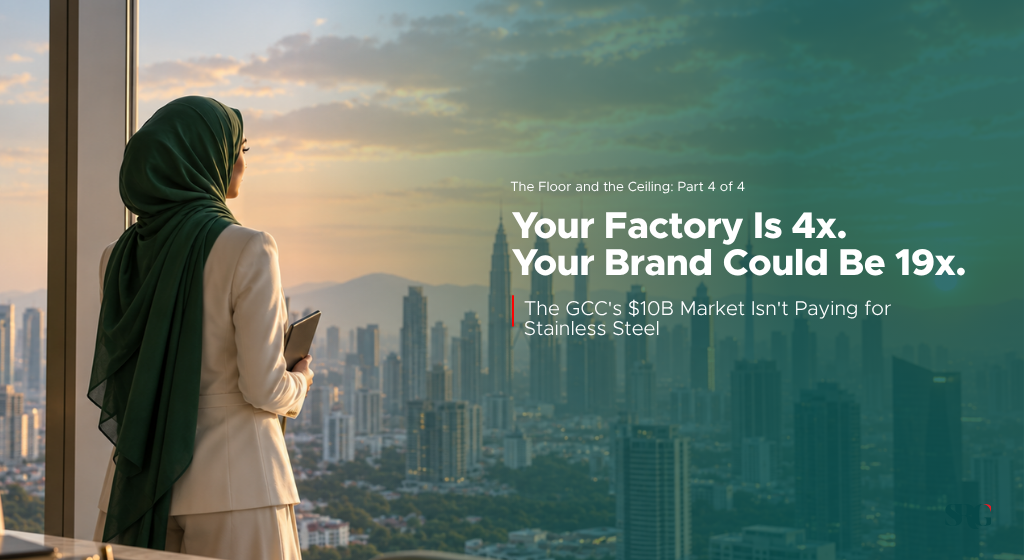
Here’s the argument that lands with anyone who has ever thought about selling. A manufacturing business, factory, equipment, the operation itself, tends to sell at around 4x EV/EBITDA. A beauty brand with a genuine following sells at 11–19x. That’s not a rounding error. It’s the difference between selling a machine shop and selling a brand that acquirers line up to buy.
L’Oréal didn’t pay USD 4.6 billion for Creed’s factory. Henkel didn’t pay USD 1.4 billion for Olaplex’s production line. They paid for the brand: the consumer trust, the recognition, the relationship. The acquirer already has the factory. They wanted the ceiling, not the floor.
“Every year that capital stays in the factory is a year spent building the 4x asset instead of the 19x one.”
What this means if you’re not planning to sell
You don’t have to be planning an exit for this to matter. The same logic applies to partnerships, distribution deals, and investor conversations. A brand that carries its own manufacturing overhead is a harder story to fund, because the fixed cost sits between the investor and the return. A brand that contracts its production is leaner, faster, and easier to scale, which is exactly what a buyer, a partner, or a pharmacy chain wants to hear.
Beauty CPG is the lowest-capex vertical in consumer goods, with median capex intensity of 0.10% of revenue. The market is telling manufacturers: don’t build factories, build brands. We will pay you 19x for the brand and 4x for the factory. Same revenue, same products, same shelf, different story, different value.
The floor and the ceiling

Your factory is your floor. It’s the foundation: solid, reliable, and real. But your brand is your ceiling, and the ceiling is where the value lives. The brands outcompeting you in GCC and Europe don’t own factories. They own stories, supply relationships, and shelf space, all of which compound, none of which depreciate.
You don’t have to give up the floor to raise the ceiling. But every ringgit spent raising the floor is a ringgit not spent raising the ceiling. And the market is clear about which one it’s willing to pay for.
The question isn’t whether your factory works. The question is whether your brand is worth more than your factory, and whether you’re building the one the market values or the one it doesn’t.